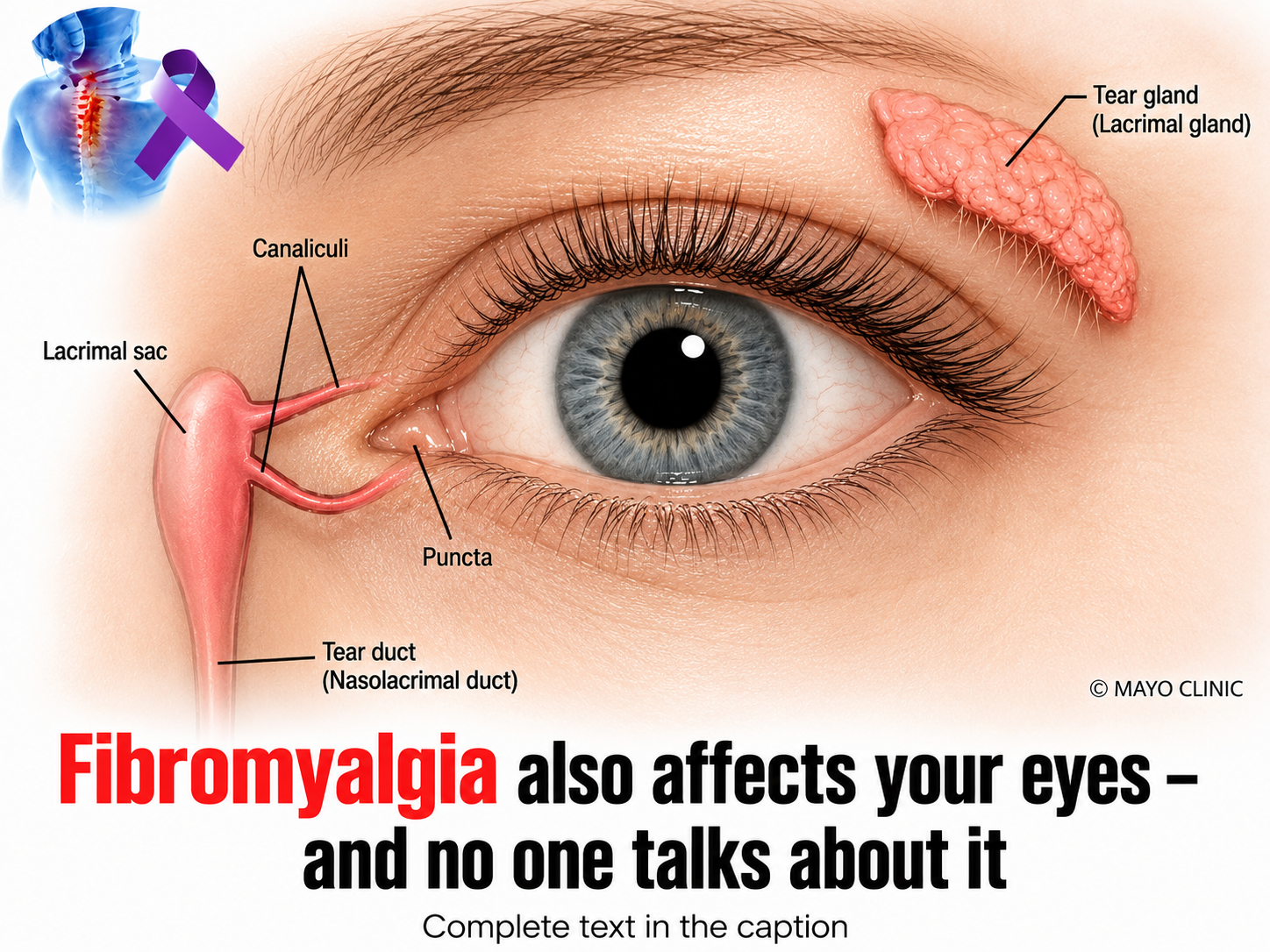
Fibromyalgia also affects your eyes — and no one talks about it.
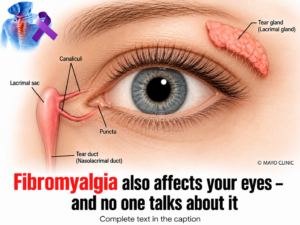
💜 Fibromyalgia and Eye Problems: Symptoms You Shouldn’t Ignore
Fibromyalgia is a complex chronic condition best known for widespread pain, severe fatigue, sleep problems, and increased sensitivity to sensory stimuli. But its effects can extend beyond muscles and joints.
Research has found that some people with fibromyalgia experience significant eye-related symptoms, particularly dry eyes, eye discomfort, burning, irritation, light sensitivity, and visual disturbances.
🔸️ Common Eye Symptoms Associated With Fibromyalgia
People living with fibromyalgia may experience:
▪️ Burning or stinging eyes – The eyes may feel irritated, sore, or as though there is something stuck in them.
▪️ Dry eyes – Reduced tear production or an unstable tear film can cause dryness, irritation, and discomfort.
▪️ Blurred or fluctuating vision – Vision may temporarily become unclear, particularly when the eyes are dry or tired.
▪️ Light sensitivity (photophobia) – Bright sunlight, headlights, phone screens, or computer monitors may become uncomfortable.
▪️ A gritty or foreign-body sensation – Some people describe the feeling as though sand or dust is trapped in the eyes.
▪️ Eye pain or aching – Eye discomfort can occur even when there is no obvious eye disease.
▪️ Redness and irritation – Dryness and irritation may contribute to red or uncomfortable eyes.
▪️ Excessive watering – Paradoxically, dry eyes can sometimes trigger reflex tearing.
These symptoms can make reading, driving, working on a computer, watching television, or using a phone more difficult.
🔸️ What Does Research Say?
Research has increasingly examined the connection between fibromyalgia and eye symptoms.
One study found that 67% of patients with fibromyalgia reported eye pain, while dry-eye symptoms were also frequently reported. The researchers emphasized that eye pain and dry eye can occur in people with chronic pain conditions generally, so these symptoms should not automatically be attributed to fibromyalgia.
A 2025 study found higher rates of dry-eye disease and meibomian gland dysfunction in people with fibromyalgia compared with healthy controls. In that study, dry-eye disease was detected in 60.6% of the fibromyalgia group compared with 21.4% of controls, while meibomian gland dysfunction was also more common.
More recently, a 2026 study also reported greater dry-eye findings in women with fibromyalgia and observed localized differences in retinal nerve fiber layer thickness. However, the researchers stressed that these findings should be considered possible ocular manifestations—not diagnostic tests for fibromyalgia.
🔸️ Why Might Fibromyalgia Be Linked to Eye Symptoms?
The exact relationship is still being studied. Fibromyalgia involves altered sensory processing and nervous-system regulation, which may influence how sensations from the eyes are experienced.
▪️ Increased sensory sensitivity – The nervous system may amplify sensations that would otherwise feel mild.
▪️ Corneal nerve changes – Studies have found altered corneal sensitivity in some patients with fibromyalgia, which may contribute to ocular discomfort.
▪️ Dry-eye mechanisms – Changes in tear production and tear-film stability may contribute to burning, irritation, and blurred vision.
▪️ Meibomian gland dysfunction – These glands help produce the oily layer of the tear film. Dysfunction can cause tears to evaporate too quickly and may contribute to dry-eye symptoms.
▪️ Poor sleep and fatigue – Chronic sleep problems may increase eye strain and make discomfort harder to tolerate.
▪️ Screen exposure – Long periods of staring at phones and computers can worsen dryness and digital eye strain.
🔸️ An Important Point: Eye Symptoms May Have Other Causes
Not every eye problem experienced by someone with fibromyalgia is caused by fibromyalgia.
Dry eyes, blurred vision, redness, eye pain, and light sensitivity can also occur with allergies, infections, autoimmune diseases, contact-lens problems, migraine, medication side effects, or other eye conditions.
That is why persistent or worsening symptoms deserve a proper eye examination rather than simply being blamed on fibromyalgia.
🔸️ Medications Can Also Matter
Some medications commonly used for pain, mood, sleep, or other chronic conditions may contribute to dry-mouth or dry-eye symptoms in certain people.
If you notice that your eyes became noticeably drier after starting or changing a medication, talk with your doctor or pharmacist. Do not stop prescribed medication on your own.
🔸️ Simple Ways to Reduce Eye Discomfort
▪️ Use preservative-free artificial tears when appropriate and as recommended by an eye-care professional.
▪️ Follow the 20-20-20 rule during prolonged screen use: every 20 minutes, look about 20 feet away for at least 20 seconds.
▪️ Blink consciously when using a phone or computer for long periods.
▪️ Keep screens at a comfortable distance and reduce glare.
▪️ Wear sunglasses outdoors when bright light bothers your eyes.
▪️ Avoid direct airflow from fans or air conditioners toward your face.
▪️ Consider a humidifier if your indoor environment is very dry.
▪️ Avoid rubbing your eyes, even when they feel itchy.
▪️ Stay adequately hydrated.
▪️ Get regular eye examinations, especially if symptoms persist.
🔸️ When Should You See an Eye Doctor?
Do not ignore:
▪️ Persistent or severe eye pain
▪️ Sudden changes in vision
▪️ New or severe blurred vision
▪️ Significant or persistent redness
▪️ New flashes of light or a sudden increase in floaters
▪️ A dark curtain or shadow across your vision
▪️ Severe light sensitivity
▪️ Eye symptoms that are getting progressively worse
🚨 Sudden vision loss, severe eye pain, or a new curtain/shadow over your vision requires urgent medical attention.
🔸️ What Can an Eye Doctor Check?
Depending on your symptoms, an eye-care professional may evaluate:
▪️ Tear production
▪️ Tear-film stability
▪️ The surface of the eye
▪️ Corneal health and sensitivity
▪️ Eyelids and meibomian glands
▪️ Visual acuity and refraction
▪️ Eye pressure
▪️ Retina and optic nerve when clinically appropriate
These examinations can help determine whether the symptoms are related to dry eye, another eye condition, medication effects, or something requiring additional evaluation.
🔸️ The Bottom Line
Fibromyalgia may be associated with a range of eye-related complaints, especially dryness, burning, irritation, eye pain, light sensitivity, and visual disturbances.
Research is continuing to explore how altered sensory processing, tear-film problems, corneal nerves, and other mechanisms may connect fibromyalgia with ocular symptoms. However, these symptoms should not automatically be assumed to be caused by fibromyalgia.
💜 Your eye health matters too.
If you live with fibromyalgia and regularly experience dry eyes, burning, blurred vision, eye pain, or sensitivity to light, talk with an eye-care professional and mention your fibromyalgia diagnosis.
💬 Do you experience eye problems along with your fibromyalgia? Tell us what symptoms you notice most.